Sunday, December 19, 2021

Pieces of Coloured Glass - Camel #1


"It is easier for a camel to go through the eye of a needle than for a rich person to enter the kingdom of God.” Mark 10:25


Like a silhouetted night scene of traveling magi on camels or camels simply resting in the manger's field of view, the splendour of the stained glass camel conveys a peaceful depiction of Christmas.  But were there camels around Bethlehem?  Well, the above photo is a family picture circa 1989 on the outskirts of Cairo, Egypt.  This was six months before my daughter Holly was born so it brings me joy. Cairo is also just under 600km from Bethlehem. One could feel safe in saying camels roamed the area.

Yet finding a documented camel connection specifically to Christmas, good luck! Suzy (church puppet) would have a field day with Pastor figuring out where a camel fits into the nativity and /or Epiphany.  Etched in our minds from each Christmas season is the nativity whether it’s a picture, a town creche, or in treasured figures on the mantle or under our Christmas tree.  We visualize a stable or a manger with a focus on baby Jesus, with Mary, Joseph, shepherds, and the magi. We also picture a host of animals including sheep, cows and yes, camels. Yet in Christmas scripture passages amplified by our favourite carols, while cattle lowed, angels heralded and the magi brought gifts, camel humps got bumped.

Let's return to Mark's passage and reflect on it in the context of the angels - 'Glory to God in the highest, and on earth peace to those on whom His favor rests.'  We aren't in want of smaller camels or larger eyes of needles; camels aren't scooting through the eye of a needle anytime soon.  All the more reason for those of us who are able to share our blessings and bestow glad tidings with the community to do so from the heart.

Dad joke - What was the three wisemen's favorite carol?  “Oh camel ye faithful”

                                      -----Flemming Rasmussen

Saturday, December 18, 2021

God: Weathered, Wrinkled, and Textured

 On those days when scrolling for something – anything- to bring a little joy, a little hope, the comfort of distraction, seems like a good idea… I go to Pinterest. One of my favourite scrolling topics is ‘old doors.’ I also love to come across old doors still in use when out walking or repurposed in peoples’ homes.


Old doors are fascinating: painted with many different coloured layers of oil-based paint, perhaps a layer or two of stain in between. Each door patinas over time in its own unique pattern.  The paint gets cracked by cold weather, peeled by water, and curled in on its edges by hot sun. In places the paint is chipped and worn down to the wood. Each crack shows different colours of paint. The wood has dents and divots, while the doorknob tarnishes and is polished depending on where it has been touched.


The beauty of the old door can not be replicated, and it can not be rushed.

Designers have various techniques to distress wood doors and furniture to make them look like they are old… but the new-made-to-look-old items pale in comparison to that which has weathered, wrinkled, and textured by an accumulation of experiences.


I recently finished reading and reflecting on a book by Canadian photographer Freeman Patterson. He has many photos of old doors and windows and abandoned rooms. In his book, “the Odyssey” he wrote: “Many religious groups … main enterprise is offering the ‘ultimate cosmetic’ --- life everlasting--- to people who feel unable or unwilling to cope with cracks and wrinkles they encounter in their lives on Earth.”


This gave me pause.

To think that ‘life everlasting’ is offering an ‘ultimate cosmetic’ – the idea that it matters not what happens here because some day in the next life, at the time of the Second Coming, bodies are transformed to glory, everything is new and beautiful, filled with peace, no pain, no dying.  My main enterprise – a Lutheran understanding- is not offering the ‘ultimate cosmetic,’ – the oft longed-for fountain of youth.

My experience is that church community is about the enterprise of the weathered, the wrinkled, and the textured. It is about welcome and belonging, just as we are, refugees, weary travelers, faith-seekers. It is my experience that God is found when I am most vulnerable: in suffering, in grief, in heart-ache. It is not the glory of later, it is in the ashes of now where hope and love grow, and where God’s kindom comes. Now, not tomorrow.


One need not sing very many Advent or Christmas carols before realizing that whatever joy, peace, hope, comfort, we find in them, the words and message are wrought with images of Jesus’ last days and his death, death on a cross.  This is not ‘glory’ as a cosmetic. This is real life wrestling with life’s purpose, mission, vocation, and being willing to love so much that one comes to a place where they are willing to die for another. 

Advent and Christmas hold the tensions experienced in life, and particularly focus on the risk of hoping and the risk of loving.  Hope and love are not feelings that grow overnight, not items that can be purchased. Hope and love require an accumulation of experience, of risk-taking. 


There is a story of a young person who posts all over social media how beautiful they are and that they have the most beautiful heart in world. The pics on Instagram have a gleaming, shiny, and strong heart for everyone to see. One day the young person is at an influencer’s event, showing off this magnificent heart. There is a crowd that has gathered to take selfies with the influencer and the heart.   A member of the security staff – a retired commissioner- has had enough of the fool-heartedness. Removing their security jacket, the retired commissioner walks to the centre of the crowd and looking at the young influencer, pulls out their heart.  The crowd gasps and steps back.  The heart is worn.  It is lumpy and dripping and not keeping a steady beat. There are scars and bruises and holes. The commissioner says, “This is a beautiful heart.”

 The crowd asks, “How is that beautiful, compared to the glow and perfect beating of the other heart?”  The commissioner draws in a breathe and begins to explain: “This biggest hole is from when my spouse died, part of my love went with them; this scare is the aftermath of harsh words spoken to a once-friend; this black bruise is a matter of forgiveness that I am still working on; these lumpy patches are promises that have been made to me and that I have made to others, that have not been kept; these marks are the times I loved and it was not received; these pinpricks are the helplessness I have when I am unable to help another…”  The commissioner went on and the crowd became ever more silent.

When finished speaking the commissioner was in tears and whispered, “The beauty of the heart accumulates through loving.”  With that the commissioner took out a piece of their heart, walked to the young influencer and placed it into their heart; risking the first mark of love  - the first texture- on that heart.  And then, having shared love, walked away.


Weathered, wrinkled, textured.


Our text this morning opens a door to a beautiful story that is weathered, wrinkled, and textured. It is one of few scripture texts that passes what is called the Bechdel-Wallace test, named after the cartoonist Alison Bechdel who assessed the role of women in cultural narratives. To pass the test, two or more women have to be named and have a conversation with each other about something other than a man. Here Mary and Elizabeth are named and have a conversation. For three months they are together: weathering pregnancy, watching the formation of stretch marks, experiencing textures of emotions; waiting with expectation and perhaps fear for all that will come to pass. Motherhood, parenthood, is weathering, wrinkling, and texturing of life.


In the final days of Advent, when I encounter an old door, I am going to pause and reflect on the beauty to be found in the accumulation of experience, in the risk of loving, in stretch marks, in wrinkles, in silvery-white hair… in natural patinas…

And I will wonder:

Has this old door witnessed the leaping of a child in the womb? Women filled with the Holy Spirit? Women talking about God? Has this old door felt joy from those who passed through its threshold? Has it heard the singing of rejoicing? Was it ever slammed in the face of the proud, did it welcome the hungry to be filled with good things, or close behind the rich leaving empty handed? Behind the door do the residents live secure and in peace? Has this old door been a witness to love?


Has this old door experienced God – love- in the weathered, the wrinkled, and the textured?  Does it know that it is beautiful?

Thursday, December 16, 2021

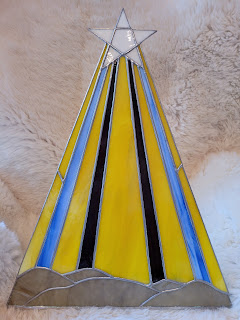
Pieces of Coloured Glass - The Star


“What hope we hold this starlit night;

a King is born in Bethlehem

Our journey long, we seek the light

that leads to the hallowed manger ground?”

“Emmanuel”


            Stars have been used by many as a means of navigation for many centuries before technology. Sailors in Newfoundland relied on them on their journeys to find their way home when the waters were ferocious and uncertain.


            The Star of Bethlehem leads the wise men and their servants on a long treacherous journey from the East (Parthia and Persia). There was a risk in their visit to Herod to discover where the “newborn King” was found since even mentioning another King was dangerous. The star leads them onward and stops where Emmanuel rests and they deliver their gifts to the King. Does the star stay after the wise men leave? Or does it guide them on another path home? The Gospel does not say.


            Faith journeys can also be like the sea at times: vast, tempestuous at times, and uncertain. Yet God is always present, like the Bethlehem star, showing us the way in times of fear and struggle if we only look to God.


God of guidance,

You gave the wise men a star to follow on the long and winding way to Bethlehem to witness to Emmanuel. Help us to place our trust in you on our own journey in faith, even when the way is long and uncertain. Amen.  

                                                         -----Victoria Featherston

Tuesday, December 14, 2021

Pieces of Coloured Glass - Joseph


As part of our Advent season, we are taking a moment to reflect on the season, and I was asked to share a devotion on what the Nativity and the members of the Holy Family mean to me. Today let us take a moment to reflect on the role that Joseph played in that Family.


Little is mentioned in scripture about Joseph or the role he played in the Holy Family. We can assume that he was a kind and loving husband and father. We know he was a carpenter; and that he was betrothed or engaged to Mary when he found that she was with child.  He stood by her and continued to provide Mary and the newborn Jesus with a stable and loving home. He adapted to a difficult situation and stayed with Mary when many would have not.


Amid this pandemic, we have all had to adapt. One thing I have learned, is that more than anything, we must remember Jesus’ greatest command, to Love your Neighbor as Yourself. In other words, treat everyone you meet as Family. This is something that most of us do naturally, but it may challenge us in these trying times. Taking a moment to wish someone well becomes a normal reaction during the Holidays but it is something I try to do everyday.  I hope that this year, we can all spend some valuable time with the ones we love.


Let us take a moment to spread some Christmas Joy to Our Community

Pray for those who are Alone, Forgotten, or in Need of Warmth, Food, or Shelter.

Remember those who are no longer with us and help us to make our world a little bit Brighter.


May the Holidays bring you comfort, and Joy

                                                                                  ------ Kevin Stanton


Sunday, December 12, 2021

Pieces of Coloured Glass - Palm Tree #2


"
The righteous shall flourish like a palm tree, he shall grow like a cedar on Lebanon."
Psalm 92:12


The straight palm tree signifies all that is wondrous about the manger scene in Bethlehem.
In Middle Eastern culture, the palm tree signified victory - we remember the triumphant entry of Jesus into Jerusalem as the crowds laid palm leaves down before Him - along with peace and eternal life.


With its crown of healthy green leaves and its strong, straight trunk that points towards heaven, this vigorous palm tree is a symbol of power and righteousness as it stands next to the manger.
But where is the victory in this humble manger, with only some straw, a few farm animals, a weary, pregnant woman and her exhausted husband and a companion palm that has been bent by the power of the wind?

For Christians, that is the best part.

For this tiny baby born on Christmas Day signifies power, triumph, peace and eternal life: the power of God, the triumph of hope and a promising future over the hardship suffered by Mary and Joseph, and the peace and eternal life that humankind longs for.
All we can hope for delivered in the form of a newborn in a simple manger, a thriving palm tree as His sentinel.

It is wondrous, indeed.


God in heaven, in this season of Advent, keep fresh in our hearts the power, joy and celebration inspired by the image of this helpless infant who triumphs over ignorance, pain, adversity and evil and brings us into your everlasting peace and the hope of eternal life. Amen.

                                                                                                            -Claire McIlveen

Saturday, December 11, 2021

The Importance of Llama Spit! - Advent 3

Philippians 4: 4-7 and Luke 3: 7-18 


While on my internship in Sault Ste Marie, ON, a parishioner invited me to spend a Sunday afternoon with her. She took me to a local animal rescue and farm just outside the city. It was jacket weather and an overcast day.  I chose to wear my flannel lined slicker… and am I ever glad I did!

In an open farmyard, people were invited to walk around with the animals – goats, chickens, geese, cats, dogs, and llamas.  How very exciting! I made friends with a llama, well I thought I had. I approached slowly, hand out. The llama looked so soft and woolly; I really wanted to pet it, hug it around the neck.   I drew close, turned, and smiled at the woman who had brought me, then turned back to the llama …. as it sneezed… well that is being kind; it spat on me.  I was so thankful to have the slicker on, as green grassy goo ran down my front.  And SMELL!

Llama spit stinks!

As I was preparing to preach, this story came to my mind. John the Baptist reminds me of a llama – he was said to be dressed in a hair garment after all.  I think connect John to a llama because what comes out of his mouth is unexpectedly hurled at the crowd.  If words could smell, -John’s words-, John’s spit-  stinks!


Brood of vipers!  Brood of snakes! he points at the crowd who has come to the river in the desert. Every bit a prophet, he warns them that the current path of the people – the path they are on- is destructive leading nowhere but to judgement and death.  John's harsh words call the people to return to the ways of God. But there is something behind the venom in the voice, the heavy speech -it is not just llama spit in the desert. Surprisingly the crowd is intrigued, engaged, and wanting more; they ask what then should we do?

Unless one was prepared to repent and change by following the direct instruction given by John- would his message not “leave a bad taste in the mouth.” And yet, that is not what the Gospel of Luke records.  The crowd is not disgusted or put-off. The crowd is expectant wondering if John is the Messiah.

The gospel notes that John’s words gave strength and heart to the crowd.

The Message! The Good News! was proclaimed.


Texts like this have me seconding guessing my tendencies and nature.  I am not a spitting llama – that actually kind of grosses me out!  Every so often a pastor will have someone ask them, usually in a tongue and cheek manner, “Isn’t it time for a little fire and brimstone from the pulpit?”  When I have been asked this, I am not sure what the person is asking or half-joking about. Is it a need to be drawn in by a charisma? A need to be told what to do? A wanting to be shocked or emotionally riled up – to feel something? To hear passion and stated truth? To not have to invest time in considering one’s part in the coming kindom of God, rather be given a check list to follow? Is it a feeling of wanting to be scolded to assuage guilt, or a need to be challenged? I don’t know.

Perhaps people are challenging the pastor to be direct and shepherd a community with proactive leadership; llama spit – where leadership passionately infuses the crowd – the church community- with words and actions that to some will leave a bad taste in their mouth. This is work we are all called to, to preach the message, the good news, and to do it without thought to the consequences or acceptance by those who come to the desert.

What if the venom, the ‘you brood of vipers’ speech, is each of us confronting the crowd that is in the wilderness? When I say crowd I think neighbours, family, friends, or perhaps a bold announcement in the centre of the food court at the mall---  you brood of vipers, snakes, telling people bluntly to get their butts to a faith community.

Go to church. Go to synagogue. Go to mosque.  That would be llama spit!


Why does that approach sound uncomfortable and drastic? It should be easy enough. Go to church.

In today’s world, consider that the church is the wilderness, the unknown- to the people, a desert where prophets like John proclaim the good news. It is a place that offers water and baptism, a call to repentance and change… and points to the One whose power working among us can do infinitely more than we can ask or imagine.


As I read the story of the crowd around John the Baptist, I wonder why they did not turn away, why they were not disgusted?  What was it in his words that gave strength to their hearts.  The people were interested and engaged. Interested –because in all his venom, John admitted  ‘it is not about me’- it is about One who is greater than me; greater than you; greater than us; the One who is coming will (as Eugene Petersen translates the passage into language of this time) ignite the kingdom life, a fire, the Holy Spirit within you, changing you from the inside out. … The One will place everything true in its proper place before God; everything false will be put out with the trash to be burned.


A crowd focused on the One greater than itself, is a crowd expectantly waiting for the One.  A crowd of individuals each with their own specific task to do … if fortune has given you 2 coats give one away, share your food; to others with good pay be satisfied with your wage; in matters of business take only what you are to take. These actions as described by John for each person don’t bring the One or draw the kindom closer.  It takes the individual actions of a wholly engaged expectant crowd to bring the kindom near.

As the coming of the One draws near, may we be bold in assembling in this wilderness, an expectant crowd. The bigger the crowd, the sooner the One will appear and the coming of the kindom will follow.

Thursday, December 9, 2021

Pieces of Coloured Glass- The Sheep


“Follow, follow

Rise up, shepherd and follow

Leave your sheep and leave your lambs,

Rise up, shepherd and follow

Leave your ewes and leave your rams,

Rise up, shepherd and follow.”


“There’s a Star in the East”


One of my favourite childhood movies to watch during Advent is “A Charlie Brown Christmas” when Linus proclaims the Gospel of Luke foretelling the shepherds’ terror when God’s angel appears to them. The film is honest: society has the tendency to become lost in the bustle and commercialism associated with Christmas. Sometimes we become afraid to rise to the challenge of what it means to be Jesus’ disciple as it sometimes means taking risks.  


In the shepherds’ story, there are questions: what happened to the sheep? Did they all follow? Sheep are not the most obedient of creatures. Did someone stay behind to look after them and miss the glorious sight? Luke does not say. He concentrates on the angel’s message. The angel’s words are an invitation to us all: to “rise up” and “follow” Jesus. To leave our ordinary lives behind and live an extraordinary Christ-like life of embodied faith with justice and kindness.  


Inviting God,

You challenge us, the ordinary, to take risks and take up the cross, joining on a journey that is extraordinary. Help us to listen with compassion and act with courage on our journey which is to be like you. In Jesus’ name we pray, Amen.  


                                                                 -----Victoria Featherston

Tuesday, December 7, 2021

Pieces of Coloured Glass - The Donkey


“There’s a crack in everything. That’s how the light gets in.” (Leonard Cohen, “Anthem”)


This was the first quotation that came to my mind upon seeing this nativity figure – though more because of the medium of glass than the donkey itself. I think that glass, which lets the light in and is also so susceptible to cracking, is very special. Stained glass art in particular, with its opacity and transparency, its hardness and fragility, reflects the blend of miraculousness and inadequacy in each individual created thing. The other line that comes to mind is from Percy Bysshe Shelley’s “Adonais,” where he writes that “Life, like a dome of many-coloured glass, stains the white radiance of Eternity, until Death tramples it to fragments.” (Although Shelley states the idea more pessimistically – “Adonais” is, after all, an elegy – this echoes the wonderful quotation from Pastor Kimber’s November 20 blog: “We are here to be eccentric, different, perhaps strange, perhaps merely to add our small piece, our little chunky, chunky selves, to the great mosaic of being.”)


Where does the donkey fit in all of this? The Bible does not actually state that Mary rode a donkey to Bethlehem; she may rather have travelled in a cart or some other way. The Bible also doesn’t specify that a donkey was present to worship at the manger, although its presence at its feed trough is both logical and explicitly referenced in Isaiah 1:3 (as Pope Benedict points out in Jesus of Nazareth: The Infancy Narratives). So perhaps the traditional image of the donkey at the manger is compromised, cracked, and also lets the light in. Through it, Jesus’s future arrival in Jerusalem on Palm Sunday shines more clearly; the past also shines through in the prophecy (Zechariah 9:9) that the King of Zion will arrive on donkeyback. Balaam’s donkey in Numbers Book 22 is one of only two talking animals in the Bible; as a messenger of God, it acts as a foil to the other talking animal, the serpent in the Garden of Eden. If our own sweet-faced glass Nativity donkey were to speak, its bray – half honk and half squeaky door – might crack us up (have a listen here if you need a refresher: https://www.youtube.com/watch?v=MfAmJKx0B1o&ab_channel=WandaKaluza ). And it might bring us special reassurance: if we can’t sing with angelic euphony, it’s okay to bray.


God, please give us the energy and strength to be the cracked vessels that you find imperfectly beautiful. Leonard Cohen urged us to “Ring the bells that still can ring. Forget your perfect offering: There is a crack, a crack in everything. That’s how the light gets in.” Please fill us with bells and light, that our cracked and braying voices may rise in praise of you.  Amen.

                                                                                             ----Shannon Brownlee

Sunday, December 5, 2021

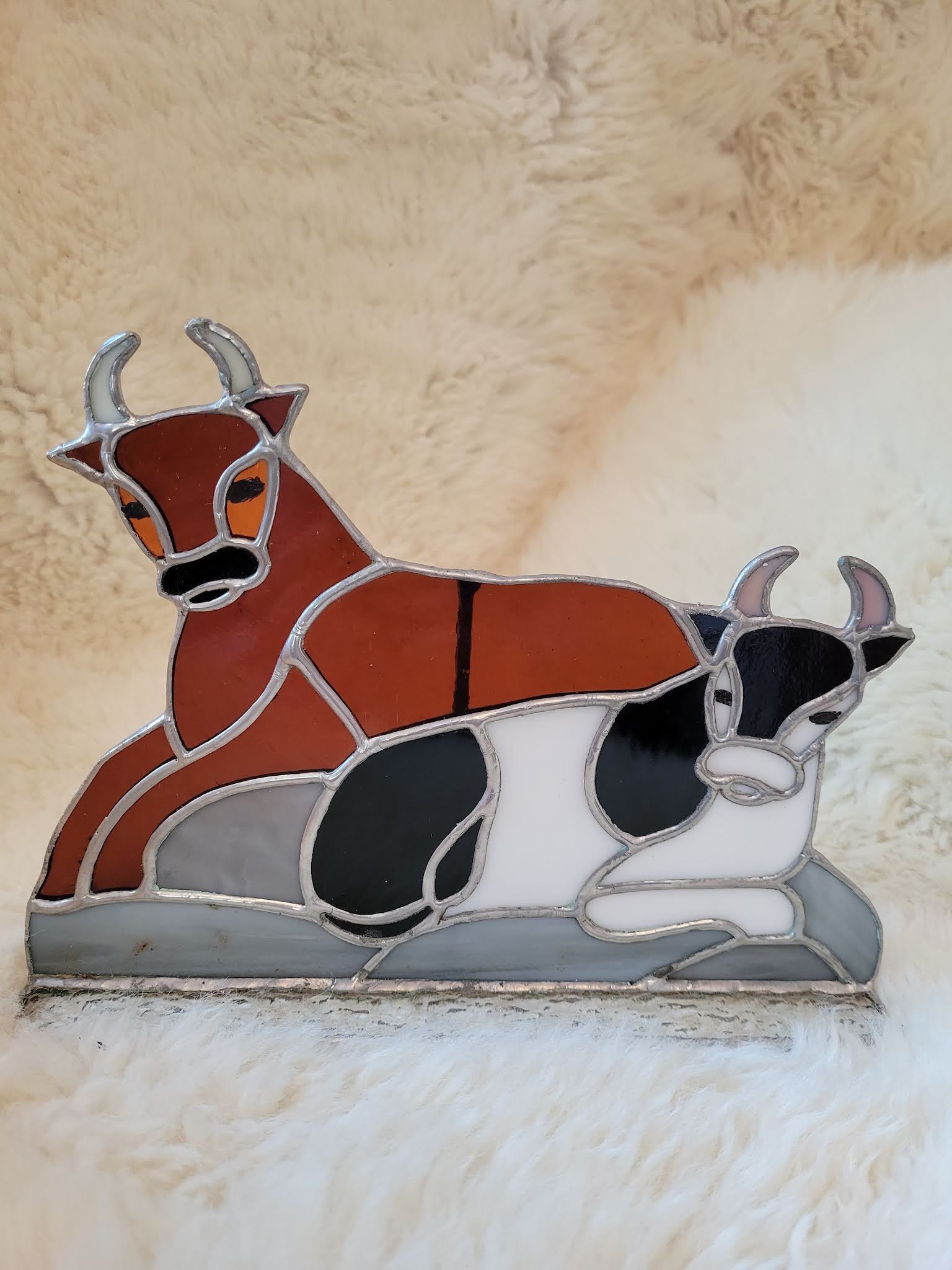
Pieces of Coloured Glass - Cow and Ox


“For even the Son of Man did not come to be served, but to serve,

 and to give his life as a ransom for many.”    Mark 10:45


It is very fitting that these animals appear in the nativity scene, although the Bible doesn’t mention their presence. Cows are a symbol of fertility, birth, and nurturing; they represent abundance, loving care, and the potential of new beginnings. Oxen are a symbol of strength, patience, hard work and sacrifice; they represent those who sacrifice themselves for the greater good. Together, the strong and patient presence of cattle offer thoughts of new life and potential, loving devotion, and self-sacrifice as deep themes for contemplation.

In these troubled times we live in, feelings of hopelessness and fear can make it tempting to shut ourselves off from it all, and focus on our own needs. And when we see the world caught up in such turbulent events, the past can seem safe and comforting. It can be hard to open ourselves up to change, and to the responsibilities of caring for the world and for all of those around us. As darkness gathers around us in this bleak mid-winter, the cow and ox represent the light of life and birth, and remind us of the hope and potential of new beginnings. They show us the true value and meaning of loving care, and the strength required to serve others. Their presence helps us see our connections to each other and to the world around us, and tells the story of love and of hope and of the power of sacrifice.


Heavenly Father, thank you for bringing us the great light of your Son to shine as a beacon in the dark. Help us to carry this light of love and hope in the world, and to truly understand the great potential of change and new beginnings. We are all your children, and can struggle with the responsibilities this brings. Help us to accept our roles in your family as loving stewards to each other and the world around us in the face of our fears, and give us the strength we need to carry this through. Amen

                                                                                  -Bonnie Petersen

Saturday, December 4, 2021

The Parable of the Pothole - Advent 2

 Luke 3: 1-6, Philippians 1: 3-11

In the northern hill country of New Brunswick weather affects one’s ability to travel in the winter and spring. Frozen ground, ice, snow, sleet, rain, water, cold temperatures; all leave their mark on the roads. Yearly these elements wreak havoc, making potholes the size of small cars and frost heaves – deep gouges that spread across the road- deep enough to bottom out a vehicle and propel it haphazardly off the farthest lip.

Locals remember from year to year where the frost heaves and potholes appear, yet often get caught, as one day the roads are smooth and the next the frost heave appears as if out of nowhere.

It doesn’t take long for the local road crew to fill their truck with sand and set out – filling the heaves and potholes with sand and packing it tightly, to make the road smooth. As the prophet said, the crooked shall be made straight, and the rough ways made smooth; and all flesh will see the salvation of God.

As the season warms and the ground thaws the road finds its equilibrium and gradually flattens out, pushing the sand out in the process. The sand disappears with rain and wind.


 This parable is told about a place where I use to live.  It is the only place I have lived -and it was only this small community in New Brunswick – where I have ever seen the filling of potholes and frost heaves with sand.

I have always wondered if the local road crew decided on their own – perhaps after losing the suspension on a vehicle or two, or because they were tired of phone calls of people complaining - to figure out a solution to the problem. They looked around the transportation yard and saw that they had lots of leftover sand in the barn, sand that would no longer be needed during the season to put on icy roads. So, they set out – without government permission, authorization, or oversight – and distributed the abundance of sand, making roads smooth, saving the bottoms of cars, and proactively stopping potential accidents. And in their work for the common good, they brought peace of mind, and gratitude from their neighbours. The community breaks out in songs of joy – well joy exhibited with less complaining and coffee and donuts taken to the road crew. Does this not sound like the kindom of God!?


A voice calls in the wilderness, “prepare the way of the Lord.”

I wrestle with the notion: is it -preparing the way of the Lord- as easy as filling potholes and frost heaves? I look around and see holes: holes in systems and services, in hearts and minds; I see individuals and peoples bent out of shape, and others heaving without purpose; I see a lack of wholeness in spirit, attitude, and being. There are gaping holes of loneliness and hopelessness.

The gospel today has John the Baptist in the wilderness – full of the 1st century equivalent to potholes and frost heaves- in the vast loneliness and hopelessness of the wilderness John comes to fill the void. He comes filling the space with words – words; a message, that depending on who you are, you will hear the words as you need to hear them, in relation to the potholes and heaves you carry and that afflict you.  The words are potentially: accusation, threat, challenge, purpose, good news, hope, and/or promise.  Not only are the words filling the minds and hearts of individuals, but also tackling the potholes and frost heaves ignored and left behind by all levels of government and religious authorities.   Without permission or consultation of the authorities, John is working at addressing the holes that inhibit the coming of the kindom of God; that inhibit individuals and the community from the joy of living in God’s presence, abundance, and love.


This year in the lectionary, we read through the Gospel of Luke.  From the very start we are acutely aware that the gospel is not going to mince words, be politically correct, or try to keep people comfortable.  This morning’s reading specifically begins by setting John the Baptist in contrast to all levels of government and authority of his time. The chapter before -which is Jesus’ birth that we read on Christmas Eve- sets Jesus in contrast to various levels of government and authority.  Luke is unapologetically political, continually setting God’s kindom in contrast to the ways of the world. Luke’s message is one that focuses on filling potholes and frost heaves – making roads smooth- through participants in the gospel, often those who are marginalized, actively engaging with hope, healing, confronting power, being rid of demons, bringing the kindom near, and receiving joy.

 Luke is not an advocate of waiting for government to fix problems, rather the gospel’s words point people to proactively prepare for the coming of the Lord, to prepare the kindom -now- fill the potholes and frost heaves; preach a message that fills the voids of loneliness and hopelessness; and reaches for joy.


This Advent I picture the burly work crew at the transportation yard in New Brunswick. Although winter is beginning, and they will be about ploughing snow and sanding icy roads- in other words busy-… there is a part of them already preparing for spring.  I see them waiting shovel in hand and sand at the ready, with a spirit to work for the common good and to share the abundance of resources available.  I see them anticipating filling the potholes and frost heaves.

This Advent I picture this community as a work crew already preparing for spring – a spring of the heart and spirit. I see us waiting with shovels in hand and sand -hope, good news, a message of ‘you are not alone’ – at the ready, with a spirit to work for the common good and to share the abundance of resources. I anticipate us filling potholes and frost heaves and bringing the kindom- now- smoothing roads and the journeys of all, were loneliness and hopelessness are no more and all pathways are paved with joy.

Thursday, December 2, 2021

Pieces of Coloured Glass - Palm Tree #1


“For in the true nature of things, if we rightly consider, every green tree is far more glorious than if it were made of gold and silver.”

— Martin Luther


A tree is truly a wonder of God’s creation.  Trees are a great source of joy for me. No matter their size or shape, I delight in their steadfast presence and beauty. As I learn more about what gifts trees provide to our earth to sustain its health, to protect humans and to provide homes for the world’s plants and animals, I am grateful for all that trees do for our world and for human survival.


Trees also offer emotional and spiritual sustenance.  Being in woods amongst the trees can bring peace and calm to a troubled mind or heart.   A tree can open us to a sense of connection with all of nature and to the Divine.  A tree expresses beauty, strength, flexibility and rootedness.  It provides protection and sustenance.  A tree is certainly glorious!


I imagine this palm tree being one of many where Mary and Joseph might have rested on their journey to Bethlehem.  It would have offered some shade and a backrest for a weary traveller - a welcome reprieve.  Perhaps it provided some fruit for eating.  The tree would ‘say’ to Mary and Joseph, “You are welcome here, my gifts of shade and support are freely given”.  It would not distinguish amongst people as to who was allowed to rest there.  Anyone could share in its gifts.


At this Advent time, this time of waiting and reflection, it is good to remember the interconnectedness of all life and how each being - whether plant, animal, tree or human - has a unique gift to offer and share.  And like the tree that shared its gift of shade and protection with Mary and Joseph, we can remind ourselves to share our love - God’s love- unconditionally with everyone, knowing that we are all part of God’s creation.


Compassionate God, creator and sustainer of All, we give thanks for this wonderful world.  We give thanks for the opportunity to live your Love by sharing our gifts with others. We ask that you give us the strength to listen and watch for those opportunities and the courage to show your Love in our actions.  Amen.


----Carolyn Humphreys

Abiding Hope in the Capacity of God AND Personal Responsibility

Let us pray: Make me to know your ways, O Lord; teach me your paths. Lead me in your truth and teach me, for you are the God of my salvati...